
If you or a family member was hurt or killed in a road accident, you can file a motor accident claim before the Motor Accidents Claims Tribunal (MACT). The claim is usually against the driver, the owner and the insurer of the vehicle that caused the accident. In most cases the insurer pays the award.
The claim is filed under Section 166 of the Motor Vehicles Act, 1988. The 2019 amendments, in force for claims since 1 April 2022, changed parts of the process and brought back a six-month time limit. The Supreme Court is now hearing a challenge to that limit, so file early and do not assume you are out of time if you are late.
In Bengaluru, these claims are heard by judges of the Court of Small Causes who also sit as members of the MACT.
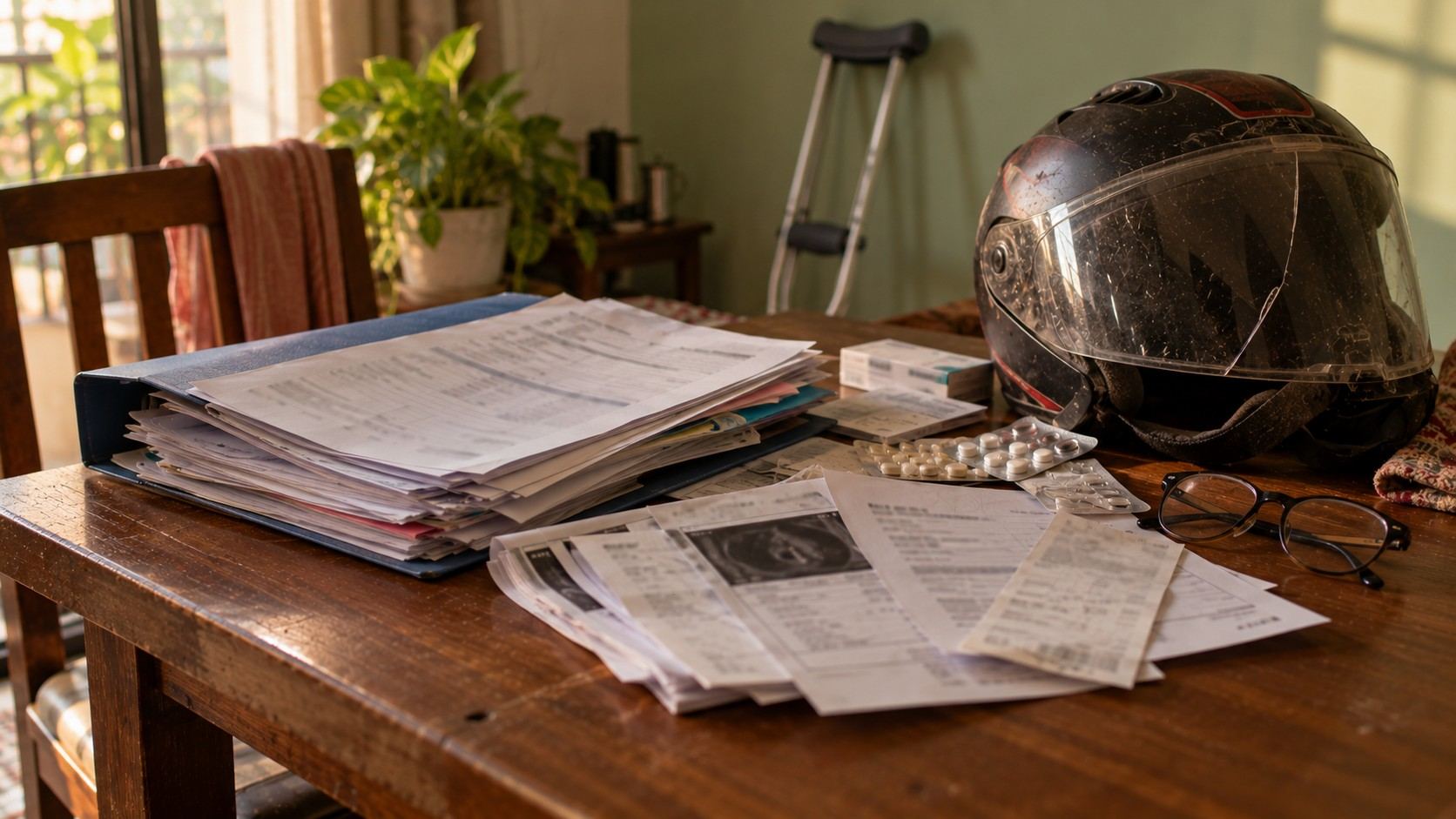
The first hours: treatment comes first
The law calls the first hour after an injury the golden hour, because treatment then makes the most difference. Two rules help here.
- The Cashless Treatment of Road Accident Victims Scheme, 2025, in force from 5 May 2025, covers treatment up to ₹1.5 lakh per victim for up to seven days from the accident, at designated hospitals. Non-designated hospitals give stabilisation treatment.
- A person who helps an accident victim in good faith is protected as a Good Samaritan under Section 134A of the Act. Bystanders should not hesitate to take someone to hospital.
The driver of the vehicle has a legal duty to get the injured person medical help and to report the accident to the police.
Documents for a motor accident claim
Start collecting these as early as you can. Most are needed for the claim petition, and missing ones cause adjournments later.
- FIR and the police’s accident reports, including the spot mahazar and sketch
- The Detailed Accident Report (DAR) the police file with the tribunal, if filed
- Wound certificate, discharge summary, and all medical bills and prescriptions
- Disability certificate from a government medical board, if there is lasting disability
- Proof of income: salary slips, Form 16, ITRs, or business records
- Proof of age: Aadhaar, school records or passport
- For a death claim: post-mortem report, death certificate, and proof of who the legal heirs are
- Vehicle details of the offending vehicle: registration number, insurance policy, driver’s licence (the police record usually has these)
Under Rule 150A of the Central Motor Vehicles Rules, the police must send a First Accident Report to the tribunal soon after the accident and later a Detailed Accident Report. The tribunal can treat the police report as a claim application. In practice, most families still file their own petition, so that the claim and the amounts are set out fully.
Section 166 claim versus no-fault compensation
There are two main routes against an identified vehicle.
| Route | What you must prove | Amount |
|---|---|---|
| Section 164 (no fault) | Only that the accident happened and involved the vehicle | Fixed: ₹5 lakh for death, ₹2.5 lakh for grievous hurt |
| Section 166 (fault based) | Rash or negligent driving of the other vehicle | Assessed by the tribunal on loss of income, medical costs, pain and suffering, and more |
For the same accident you generally have to choose one route. Most serious injury and death cases go under Section 166, because the compensation is assessed on actual loss and is usually higher.
The six-month limit and the Supreme Court case
Section 166(3), added by the 2019 amendment, says a claim will not be entertained unless it is filed within six months of the accident. Before 2022, there was no fixed limit at all, and many families filed years later.
The provision has been challenged before the Supreme Court as unfair to victims. In November 2025 the Court passed an interim order saying that, while the challenge is pending, tribunals and High Courts should not dismiss claim petitions as barred by limitation. Check the current position before you rely on that, because the case was still being heard.
Our advice is simple. File within six months if you can. If you are past six months, speak to a lawyer anyway.
Where to file in Bengaluru
Under Section 166(2), you can file before the tribunal where the accident happened, where you live or carry on business, or where the respondent lives. A family living in RR Nagar can usually file in Bengaluru even if the accident happened on a highway outside the city.
The petition names the driver, the owner and the insurer. The tribunal sends notice to all three. The insurer usually files objections, often on the driver’s licence, the policy, or whether the accident happened as described.
How compensation is worked out
For injury, the tribunal looks at medical expenses, loss of earnings during treatment, future loss of earnings if there is permanent disability, and amounts for pain and suffering and loss of amenities.
For death, the main figure is loss of dependency: the deceased’s income, plus an addition for future prospects, minus a deduction for personal expenses, multiplied by a figure based on age. The Supreme Court has set the method in a line of judgments, and tribunals follow it. Add funeral expenses, loss of estate and loss of consortium for the family.
The tribunal usually orders interest from the date of filing. Large amounts for minors are often kept in fixed deposits.
Many MACT cases in Bengaluru settle at Lok Adalats, where the insurer makes an offer. Check that offer against what a full award would be. Settling is often sensible. Settling too low is common.
Hit and run compensation
If the vehicle cannot be identified even after police efforts, you claim under the Compensation to Victims of Hit and Run Motor Accidents Scheme, 2022, not at the MACT.
- ₹2 lakh for death
- ₹50,000 for grievous hurt
The application goes to the Claims Enquiry Officer of the sub-division or taluk where the accident happened, with the FIR, the post-mortem or injury certificate, and identity and bank details. The officer sends a report to the Claims Settlement Commissioner, and payment comes from the Motor Vehicle Accident Fund. You also sign an undertaking to refund the amount if you later receive compensation for the same accident from another source.
If the police can trace the vehicle, it is not a hit and run case under the scheme, even if the driver ran away. You file a normal Section 166 claim.
When the case is also a criminal case
The police case against the driver, for causing hurt or death by negligence under Sections 281, 125 and 106 of the Bharatiya Nyaya Sanhita (earlier Sections 279, 337, 338 and 304A IPC), runs separately in the magistrate’s court. You do not have to wait for it to end. The MACT decides compensation on its own evidence. If the driver was drunk, see our note on drunk and drive cases in Bengaluru, and for the wider picture of who decides what, our Bengaluru courts guide.
Questions people ask
What is the time limit to file a motor accident claim?
Section 166(3) says six months from the accident. The Supreme Court has, by an interim order of November 2025, told tribunals not to dismiss late claims on that ground while it decides the challenge, so speak to a lawyer even if you are late.
How much compensation is given for a hit and run death?
Under the 2022 scheme, ₹2 lakh for death and ₹50,000 for grievous hurt, where the vehicle cannot be identified.
Can I claim if I was a pillion rider or a pedestrian?
Yes. Pedestrians, passengers and pillion riders can all claim against the vehicle at fault and its insurer, subject to the terms of the policy.
Who pays the compensation, the driver or the insurance company?
If the vehicle was insured, the insurer usually pays. Where the insurer proves a policy breach, such as no valid licence, the tribunal may still ask the insurer to pay and then recover from the owner.
Is a lawyer needed for a MACT claim?
You can file yourself, but insurers are always represented. The amount turns on evidence of income, disability and dependency, which is where careful preparation makes a difference.
Talk to us about your matter
Call or WhatsApp to fix a time. Bring your papers to the office in Rajarajeshwari Nagar.
This article is general information about the law as it stood when it was written. Your facts change the answer. Speak to an advocate before you act on it.