
An e khata (ಇ-ಖಾತಾ) is the digital property record kept by the Greater Bengaluru Authority (GBA) and the five city corporations that replaced the BBMP in September 2025. You apply for it, and download it, on the e-Aasthi portal at bbmpeaasthi.karnataka.gov.in. Most owners can do it themselves from a phone, without visiting an office.
You need the e-khata to sell, gift or mortgage most properties in the city. The Stamps and Registration Department has told sub-registrars not to register property in corporation and panchayat areas without it. So if a sale is coming up, get this done first.
This page explains the steps, the documents, what changes for rural areas, and the cases where a simple online application is not enough and a lawyer should look at the papers.
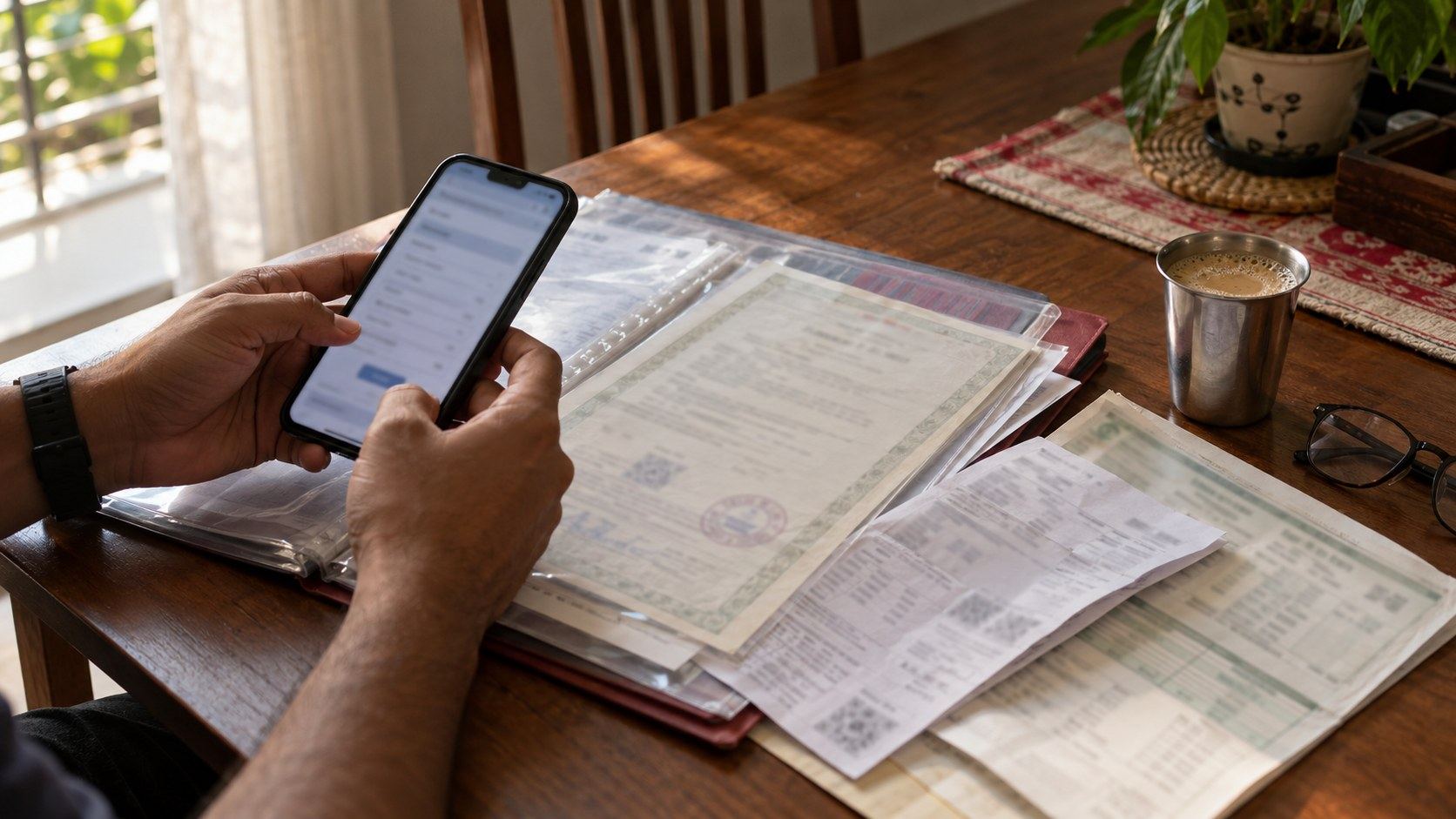
How to apply for e-khata online
The portal was upgraded to eAasthi 2.0 in September 2026. Screens may look different from older guides, but the steps are broadly the same:
- Open bbmpeaasthi.karnataka.gov.in and log in with your mobile number and the OTP.
- Find your draft e-khata. You can search by ward and owner name, by the e-property ID (ePID), or by your property tax (SAS) application number from a recent tax receipt.
- Check every detail on the draft: owner names, property type, site measurements, built-up area.
- Choose the option to submit information for the final e-khata and upload or enter the documents listed below.
- Complete Aadhaar e-KYC for each owner.
- Submit and note your application number. You can now track the application through each stage of verification on the same portal.
If everything matches the Kaveri registration records and the BESCOM database, the final e-khata can come through quickly. In 2026 GBA officials said most applications were cleared in a few days, and that cases needing mutation or corrections could take 10 to 15 days. Your case may take longer if anything does not match.
Documents you need
Keep these ready before you log in:
- Registered deed number (sale deed, gift deed, partition deed). For deeds registered on or after 1 April 2004, the portal can pull the details from Kaveri. For older deeds, you upload a copy.
- Aadhaar of every owner, for e-KYC. Owners without Aadhaar, such as some NRIs, have been handled at the Assistant Revenue Officer (ARO) office with other ID.
- Property tax details, usually the SAS application number on your tax receipt.
- BESCOM account number (10 digits), if the property has an electricity connection.
- Photograph of the property, and its location marked on the map. For an apartment, a photo of the building from outside.
- Khata certificate or extract from the old system, if you have it.
An encumbrance certificate (EC) is not compulsory for getting the e-khata itself. It is still needed when you use the e-khata for registration at the sub-registrar office or for mutation. Our guide to the encumbrance certificate explains how to get one on Kaveri.
How to download your e-khata
Once the final e-khata is issued, you can download it from the same portal. Search by your ePID or SAS number, pay the small download fee online, and save the PDF.
Keep the PDF with your title papers. The buyer’s lawyer and the bank will both ask for it.
Why e-khata applications get rejected or held up
A rejection or a “sent back” status almost always means something does not match. The common reasons are:
- the name on the sale deed is spelt differently from the name on Aadhaar or the tax record
- the site measurements or built-up area on the draft differ from the deed
- property tax is unpaid, or paid against the wrong property ID
- the property is in the B register, or the building has floors beyond the sanctioned plan
- the land is marked for a road, a storm water drain or another public use, or is government land
- two people claim the same property, or someone has objected to the draft
For a spelling or measurement error, eAasthi 2.0 has an online correction option, and the ARO can fix it. For an objection or a competing claim, the ARO will look at title documents, and this is where the e-khata becomes a legal question rather than a data entry problem.
Fixing a rejection: what to do
Read the reason given on the portal first. Then:
- Data mismatch: apply for correction online, attaching the deed page that shows the correct figure or spelling. GBA has asked citizens to raise complaints on its e-khata helpline, 94806 83695, rather than queue at offices.
- Missing documents: upload what was missing and resubmit. If you cannot get a document, the ARO help desk can tell you what they will accept instead.
- Tax arrears: pay the arrears and penalty on the property tax portal, then resubmit.
- Objection or dispute: do not keep resubmitting. Get the full title chain read. If there is a rival claim, you may need to reply to a notice, go before the revenue officer, or in some cases go to civil court.
Do not pay agents who promise a faster e-khata. GBA has publicly warned citizens against middlemen.
E-khata in Bengaluru rural areas
People searching “e khata Bangalore rural” usually own a site in a gram panchayat area just outside city limits. Those properties are not on e-Aasthi. Their records are kept by the Rural Development and Panchayat Raj Department on the e-Swathu system (eswathu.karnataka.gov.in), where the record is issued as Form 9 or Form 11. You usually start at the gram panchayat office.
Properties inside a town municipality or city outside Bengaluru follow that local body’s system. The difference between these records is explained in our article on A-khata, B-khata and e-khata.
When you need a lawyer for e-khata
Most owners with a clean registered deed and paid-up tax will not need one. Get legal help when:
- the draft e-khata shows someone else as owner, or a name you do not recognise
- the original owner has died and the property has to come to the heirs (see khata transfer)
- the property was bought on a GPA or agreement, not a registered sale deed
- the e-khata shows the B register and you want to move to A (see B-khata to A-khata conversion)
- a neighbour or relative has objected, or there is a court case on the land
We read the deeds, tell you what the record should show, and prepare the reply or application for the ARO. Rules here have changed several times since 2024, so we check the current portal position before advising.
Questions people ask
Is e-khata mandatory in Bengaluru?
For registering a sale, gift or mortgage of most properties within corporation limits, yes. Sub-registrars have been directed not to register without it. It is also required for building plan approval.
How many days does it take to get e-khata?
If all details match, it can be a few days. Corrections, mutation or objections can take 10 to 15 days or more.
Can I get e-khata for a B-khata property?
Yes. A B register property gets a B e-khata. Getting the e-khata does not regularise the property or make it A-khata.
Is e-khata proof of ownership?
No. It is a tax and property record. Ownership comes from the registered title deeds and the chain behind them.
How do I get e-khata for a site in a gram panchayat?
Panchayat properties use e-Swathu, not e-Aasthi. Apply through the gram panchayat for Form 9 or Form 11.
Talk to us about your matter
Call or WhatsApp to fix a time. Bring your papers to the office in Rajarajeshwari Nagar.
This article is general information about the law as it stood when it was written. Your facts change the answer. Speak to an advocate before you act on it.