
The family courts for Bengaluru city sit together in one building: the Nyayadegula complex on H. Siddaiah Road, in the Shanti Nagar and Sudhama Nagar area, Bengaluru 560027. Divorce, maintenance, custody and most other marriage cases from across the city are heard there, including cases from RR Nagar, Kengeri and Uttarahalli.
If you have received a summons from the family court, or you are about to file a case, this article covers three things: how to find the court, how to check your case status online, and what the first hearing usually looks like. None of it requires you to be a lawyer to understand.
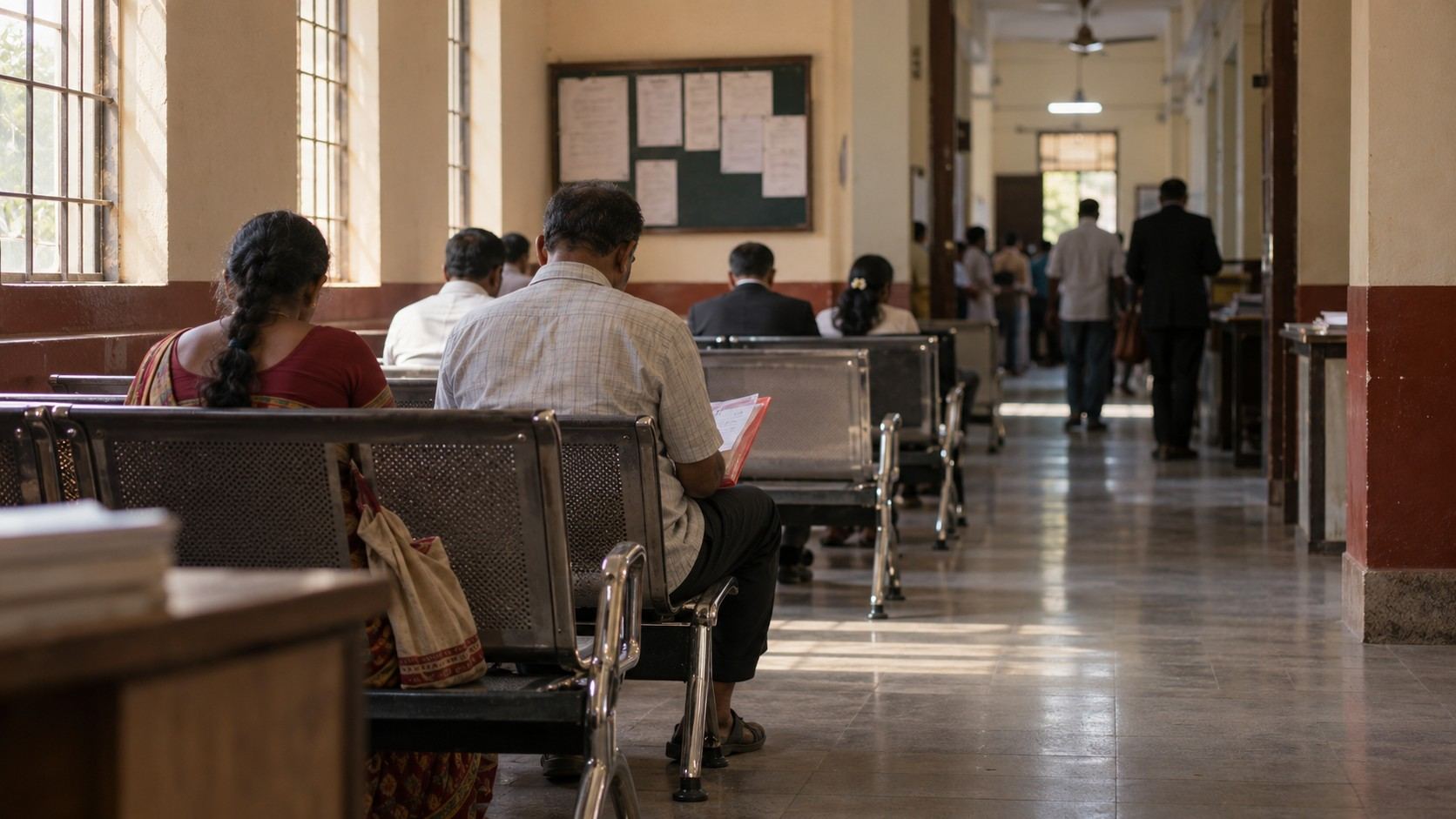
Where the family court in Bengaluru is
The Bengaluru district court website lists the family courts unit at the Nyayadegula complex, Siddaiah Road, Bengaluru 560027, with the phone number 080-22220808. People often call it the “Shanti Nagar family court” because of the locality. It is off the road that runs from Lalbagh’s main gate towards the Shanti Nagar bus station on Double Road.
Several family courts work from the same complex. There is a Principal Judge, Family Court, and a number of additional family courts. Your summons or case papers will say which court hall your case is in. If you are not sure, the court office can tell you.
From RR Nagar 5th Stage and the south-west of the city, most people come in by Mysore Road and then through the city centre. Allow extra time on a weekday morning, because the first call of cases starts soon after the court sits.
What the family court decides
The Family Courts Act, 1984 sends these kinds of cases to the family court instead of the regular civil court:
- divorce, judicial separation, annulment and restitution of conjugal rights
- disputes about property between husband and wife
- custody and guardianship of children
- maintenance for a wife, children or parents, including cases under Section 144 of the Bharatiya Nagarik Suraksha Sanhita (earlier Section 125 CrPC)
- declarations about the validity of a marriage or a person’s legitimacy
Some family disputes go elsewhere. A criminal complaint of cruelty under Sections 85 and 86 of the Bharatiya Nyaya Sanhita (the old 498A IPC) is a criminal case and is tried by a magistrate. A complaint under the Domestic Violence Act is also usually filed before a magistrate. Our articles on Section 498A under the BNS and domestic violence cases explain those routes.
How to check family court case status in Bengaluru
Family court cases are on the national eCourts system, the same one used by other district courts.
- Go to the eCourts services website (services.ecourts.gov.in) or download the eCourts Services app.
- Choose Karnataka as the state and Bengaluru as the district.
- Select the court establishment for the family courts. It appears under a name like “Prl. Judge Family Court, Bengaluru”.
- Search by case number and year, by party name, or by the 16-character CNR number printed on your case papers.
The result shows the next date, the stage of the case and, often, the orders passed so far. The CNR number is the quickest search, because it is unique to your case. Our step-by-step guide to family court case status in Bengaluru covers common errors, such as a case that does not show up at all.
The online status is a record of what happened. It is not always updated on the same day, so for a hearing tomorrow, confirm the date with your advocate or the court office.
What happens at the first hearing
The first date after a summons is usually short. In most cases:
- The court calls the case and notes who is present.
- If you are the respondent, the court records your appearance. If you have an advocate, they file a vakalath.
- The court gives time to file your written statement or objections, and fixes the next date.
- In maintenance cases, the court may ask both sides to file an affidavit of assets and liabilities, a format the Supreme Court made standard in Rajnesh v. Neha (2020).
You do not argue the whole case on the first day. Nobody expects that.
Settlement and mediation come early
The Family Courts Act puts a duty on the family court to try for a settlement first (Section 9). In practice, the court often refers the couple to mediation or counselling before the case goes to evidence. Mediation is private, and what is said there is not used as evidence later. It does not mean you must agree to anything. Many couples use it to settle maintenance, custody or the return of belongings even when the divorce itself is contested.
Hearings can be private
Under Section 11 of the Act, a family court may hold proceedings in camera, and must do so if either party asks. If you are uncomfortable speaking about personal matters in an open hall, tell your advocate so the request can be made.
If you miss a date
If the respondent does not appear after being properly served, the court can proceed ex parte, which means it hears only the other side. A decree passed this way can sometimes be set aside if there was a good reason for not appearing, but it means extra applications and delay. If you cannot attend, send your advocate or, at the least, inform the court in writing.
If the person who filed the case stops appearing, the court can dismiss it for default.
Do you need a lawyer in family court?
The Family Courts Act says no party is entitled to a lawyer as of right (Section 13). In practice, family courts in Bengaluru routinely allow advocates, and most people are represented, because the case involves pleadings, affidavits and cross-examination. You can also appear in person if you choose. Ask the court for permission if you want an advocate and the other side objects.
If you are the one filing, the petition is usually filed in the family court with jurisdiction over the place where the marriage took place, where you last lived together, or in some cases where the wife now lives. For the main routes, see our page for a divorce lawyer in Bangalore.
Appeals from the family court
A final judgment of the family court can be appealed to the High Court of Karnataka. Section 19 of the Family Courts Act says the appeal must be filed within thirty days. No appeal lies from a decree passed with the consent of both parties, such as a mutual divorce. The time limit is short, so speak to an advocate soon after the judgment.
Questions people ask
Where is the family court in Bangalore?
The family courts for Bengaluru city are in the Nyayadegula complex on H. Siddaiah Road, in the Shanti Nagar and Sudhama Nagar area, PIN 560027. The court office phone listed on the district court website is 080-22220808.
How can I check my family court case status in Bangalore?
Use the eCourts services website or app, choose Karnataka and Bengaluru, select the family court establishment, and search by CNR number, case number or party name. The CNR number on your papers gives the most reliable result.
Can I attend family court without a lawyer?
Yes. You can appear in person and explain your side. Most people still use an advocate because family cases involve written pleadings, affidavits and evidence.
Are family court hearings open to the public?
The family court can hold hearings in private, and must do so if either party asks. Mediation sessions are always private.
What happens if I do not go to family court after a summons?
The court may decide the case without hearing you. If you have a genuine reason, inform the court or send an advocate, and apply quickly if an ex parte order has already been passed.
Talk to us about your matter
Call or WhatsApp to fix a time. Bring your papers to the office in Rajarajeshwari Nagar.
This article is general information about the law as it stood when it was written. Your facts change the answer. Speak to an advocate before you act on it.