
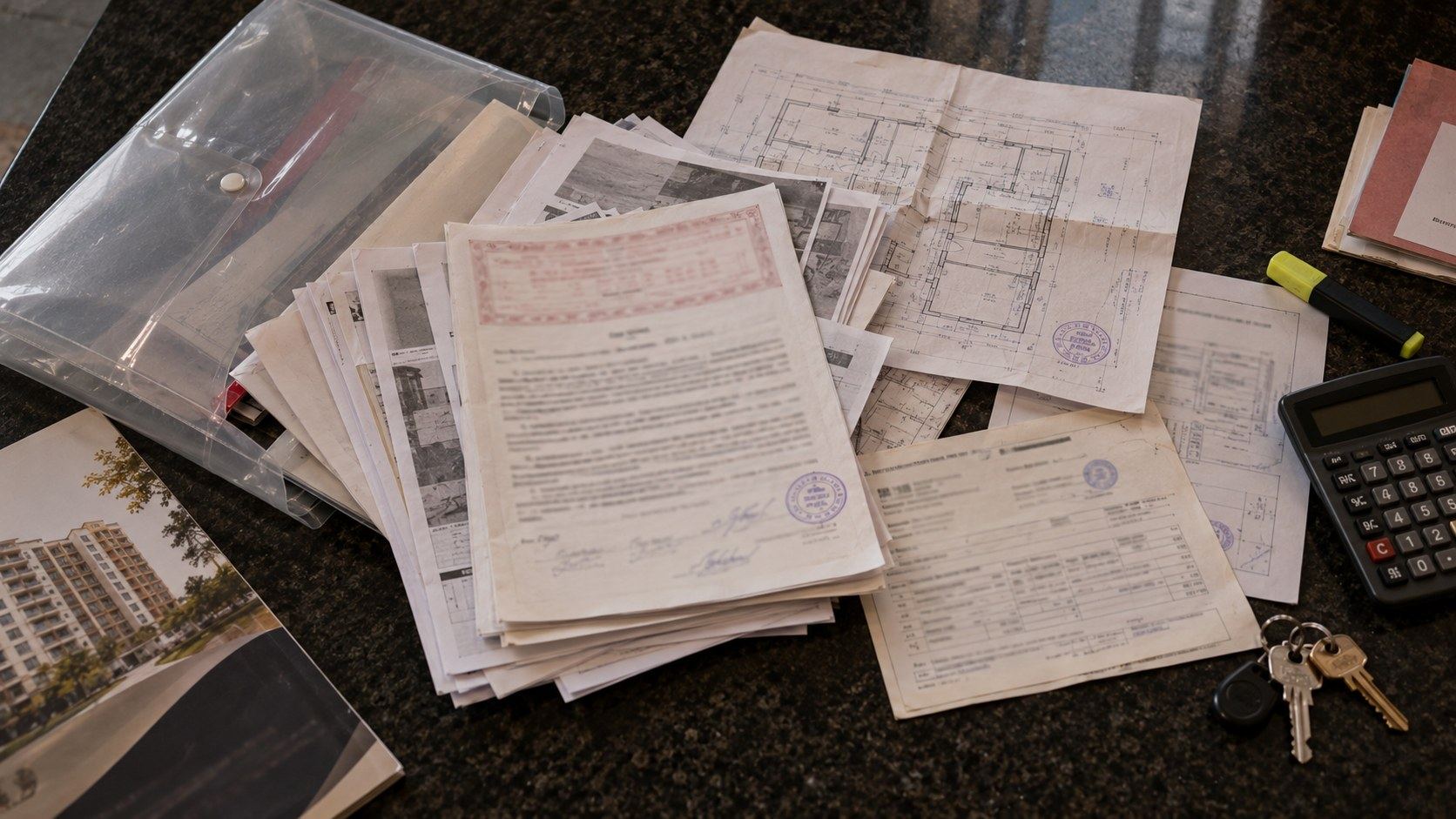
The sales office will hand you a neat folder. It will have a brochure, a price sheet, and a few photocopies with stamps on them. None of that tells you whether the builder had the right to build on that land, or whether the flat you are paying for can be registered, mortgaged and sold later.
This is the list we work through when someone in Bengaluru asks us to check an apartment before they sign. You can do some of it yourself. The parts that need reading old deeds or spotting gaps in a title chain are where a lawyer earns the fee.
1. Who owns the land, and since when
An apartment sits on land, and that land has a history. The builder rarely owns it outright. More often a landowner signed a Joint Development Agreement (JDA) with the builder and gave a share of flats in return.
Ask for:
- the mother deed, meaning the oldest document showing how the land came to the family or company that owns it
- every sale deed, gift deed, partition deed or will after that, up to the current owner
- the JDA and the General Power of Attorney the landowner gave the builder
We look at roughly 30 years of history. Each link in the chain must connect cleanly to the next. A missing link, a sale by one brother without the others signing, or a will that was never probated, are the problems that end up in court ten years later.
2. Encumbrance Certificate (EC)
The EC, called ಋಣಭಾರ ಪ್ರಮಾಣಪತ್ರ at the sub-registrar office, lists every registered transaction on a property for the period you ask for. Form 15 shows transactions. Form 16 means there were none in that period.
You can apply for an EC online through the Karnataka Kaveri portal. Ask for the same 30-year period as the title check, and check that:
- the sellers in the EC match the names in the title documents
- there is no mortgage that has not been released
- there is no sale of the same land to someone else
- the survey number and extent match the other documents
An EC only shows registered transactions. An unregistered agreement, a pending court case or a family dispute will not appear on it. That is why it is one check among many, not the whole check.
3. Land conversion and RTC
Most of Bengaluru’s apartments stand on land that was once farmland. Before anything can be built, the land must be converted to non-agricultural use by an order of the Deputy Commissioner.
Ask for the conversion order and the RTC (pahani) extracts from the Bhoomi records. The RTC should show the land moving out of agricultural use. If the RTC still shows crops being grown and there is no conversion order, stop and ask why.
4. Approved building plan and layout
The building must have a plan sanctioned by the right authority: the city corporation, BDA, BMRDA or the local planning authority, depending on where it is.
Check:
- the number of floors and flats in the sanctioned plan against what is actually being built
- the setbacks and parking shown on the plan
- whether your flat number appears in the plan
Extra floors added beyond the sanctioned plan are a common problem in Bengaluru. Those flats may never get an occupancy certificate.
5. Commencement and Occupancy Certificates
The Commencement Certificate (CC) shows the builder was allowed to start work. The Occupancy Certificate (OC) shows the finished building was inspected and found to match the plan.
For a ready flat, do not buy without an OC. Without it, you may struggle with water and electricity connections, with the khata, and with selling the flat later. For an under-construction flat, the agreement should make the OC a condition of handing over possession.
6. Khata and property tax
The khata is the record that a property is assessed for tax by the city corporation. In Bengaluru there are A-khata, B-khata and, more recently, e-khata records. For an apartment, you want a clear A-khata or e-khata for your flat after registration, which depends on the builder’s land and building being in order.
Ask for the khata of the land or the building and the latest property tax receipts. Our article on A-khata, B-khata and e-khata explains the difference.
7. RERA registration
Most ongoing residential projects above a certain size must be registered with K-RERA (the Karnataka Real Estate Regulatory Authority). Look up the project on the K-RERA website. The registration page shows the promoter, the approvals uploaded, the promised completion date, and any complaints against the project.
If a project that should be registered is not, that is a serious warning sign.
8. The agreement you are about to sign
The agreement for sale and the construction agreement are written by the builder’s lawyers. Read them, or have them read, before you pay the booking amount if you can. Look at:
- carpet area in square feet, and how the price is worked out
- the possession date and what you get if it is delayed
- what happens if you cancel, and how much is forfeited
- the undivided share of land (UDS) that comes with your flat
- who pays registration, stamp duty, BESCOM and BWSSB deposits, and the maintenance corpus
9. Bank approval is not a legal check
Buyers often say, “The bank has approved the project, so it must be fine.” A bank’s approval helps, but the bank is checking its own risk on the loan. It is not a title opinion for you. Get your own.
Questions people ask
Can I verify property documents online in Bangalore?
Partly. The EC can be applied for on the Kaveri portal, RTC and land records are on Bhoomi, and RERA projects can be searched on the K-RERA website. Reading a 30-year title chain and judging whether it is clean still needs a lawyer.
How long does a property document verification take?
For a ready apartment with a complete set of documents, usually a few working days. If records have to be pulled from the sub-registrar or the land records office, it takes longer.
Is it safe to buy a flat without an OC?
It is risky. Without an OC, khata, utility connections and resale can all become problems. For a ready flat, insist on seeing the OC.
What does a property lawyer check that I can’t?
Whether each transfer in the title chain was valid, whether all legal heirs signed, whether the power of attorney to the builder covers the sale, and whether there are pending cases on the land. A checklist can’t answer those. Reading the deeds can.
Talk to us about your matter
Call or WhatsApp to fix a time. Bring your papers to the office in Rajarajeshwari Nagar.
This article is general information about the law as it stood when it was written. Your facts change the answer. Speak to an advocate before you act on it.