
Sale deed registration is the step that actually transfers ownership. Under the Transfer of Property Act, a sale of immovable property worth Rs 100 or more has to be made by a registered document. In Bengaluru that happens at a sub-registrar office (SRO), booked and paid for through the Kaveri 2.0 portal of the Department of Stamps and Registration.
For most properties in Bengaluru, budget about 7.6% of the value for government charges: 5% stamp duty, around 0.6% cess and surcharge, and a 2% registration fee. The registration fee was doubled from 1% to 2% from 31 August 2025. The value used is the higher of the price you agreed and the government’s guidance value for that area.
Before any of this, the property must have an e-khata. Sub-registrars have been directed not to register property in corporation and panchayat areas without one.
Before registration: what must be ready
- Title checked. Get the title chain, EC and approvals read before you pay the full price. Our apartment document checklist covers what to look at.
- E-khata in the seller’s name. See our e-khata guide.
- Fresh EC up to a recent date. See encumbrance certificate.
- Loan sanctioned, if you are borrowing. The bank will usually send its own draft or review yours, and will want the original deed after registration.
- TDS paid. For property of Rs 50 lakh or more, the buyer has to deduct TDS at 1% from the payment to a resident seller and deposit it. The rules for NRI sellers are different. Ask your chartered accountant before the payment date.
- Final draft of the sale deed agreed by both sides.
What the sale deed should say
A sale deed is not a form to fill. It is the document a court will read if anything goes wrong. It should include:
- full names, ages, addresses and ID of the seller and buyer
- how the seller got the property, with the earlier deed numbers
- the full property description: survey number, site or flat number, e-khata ePID, measurements and the four boundaries
- for a flat, the undivided share of land, car park and common areas
- the price and how it was paid, with cheque or transfer details
- a promise from the seller that the property is free of loans, claims and cases, and that the seller will make good any loss if this is untrue
- when possession is handed over
Stamp duty and registration fee in Karnataka
| Charge | Rate for a sale deed (most Bengaluru properties) |
|---|---|
| Stamp duty | 5% of the higher of price and guidance value |
| Cess and surcharge on stamp duty | About 0.6% of value in urban areas |
| Registration fee | 2% (from 31 August 2025; earlier 1%) |
| Total | About 7.6% |
On a flat registered at Rs 1 crore, that is roughly Rs 7.6 lakh. Lower stamp duty rates have been offered for lower-value apartments in some past years. Use the fee calculator on Kaveri to see the exact figure for your document, because rates and concessions change.
You pay these charges online through the Kaveri system before your appointment.
The Kaveri 2.0 registration process, step by step
- Log in to kaveri.karnataka.gov.in with your mobile number and OTP.
- Enter the document details: the type of document (sale deed), the parties, the property and the value. Many people have a lawyer or document writer do this data entry.
- Upload the draft sale deed and supporting documents.
- The SRO checks the data and either approves it or sends it back with comments.
- Pay stamp duty and registration fee online. The portal calculates the amount.
- Book a slot at the sub-registrar office for your property’s area.
- Visit the SRO on the appointment day.
At the sub-registrar office
On the day, the seller, the buyer and two witnesses go to the SRO with original ID. If someone is holding a power of attorney for a party, bring the original registered POA (see power of attorney).
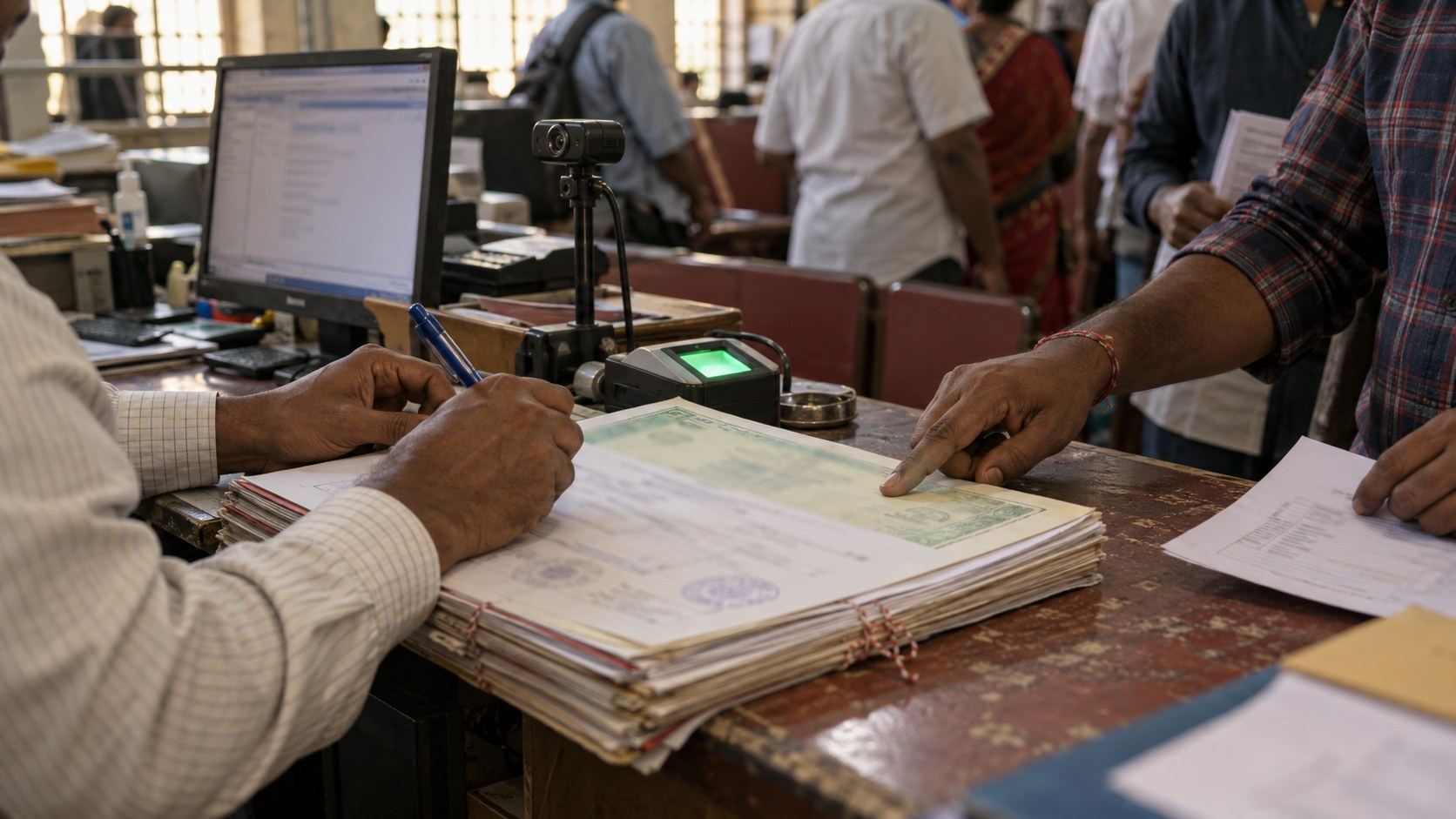
At the counter:
- the parties are identified, and Aadhaar authentication is usually done
- the SRO takes photographs and thumb impressions
- the parties confirm, in front of the officer, that they signed the deed and agree to it
- the document is registered and scanned
You get the registered document back, usually the same day. Keep the original safe. Banks hold it if there is a loan.
In August 2026 the Karnataka Assembly passed a bill to allow some documents to be registered without the parties appearing in person. Until it comes into force and the rules are issued, plan for an in-person visit.
After registration
- Check the e-khata moves to your name. Our khata transfer article explains how.
- Change the BESCOM and BWSSB accounts. eAasthi 2.0 allows the request online.
- Pay the next property tax in your name.
- Get a certified copy later if you need one, from Kaveri.
When a lawyer is worth it
A lawyer earns the fee before registration, not at the counter. Get one when the seller is an heir or a GPA holder, when the property came through a gift or partition, when the EC shows an old mortgage, when one co-owner lives abroad, or when the builder’s draft is one-sided. We read the title, draft or check the sale deed, and attend the SRO if needed.
Questions people ask
What is the stamp duty for sale deed registration in Bangalore?
For most properties, 5% of the higher of the sale price and guidance value, plus cess and surcharge of about 0.6%. The registration fee is a further 2%.
When did the Karnataka registration fee increase to 2%?
The registration fee went up from 1% to 2% from 31 August 2025.
Can a sale deed be registered without e-khata in Bengaluru?
For properties in corporation and panchayat limits, sub-registrars have been directed not to register without an e-khata.
How long does sale deed registration take?
Data entry and SRO approval can take a few days. The SRO visit itself usually takes a few hours, and you normally get the registered deed back the same day.
Who pays stamp duty, buyer or seller?
The buyer usually pays stamp duty and registration fee, unless the agreement says otherwise.
Talk to us about your matter
Call or WhatsApp to fix a time. Bring your papers to the office in Rajarajeshwari Nagar.
This article is general information about the law as it stood when it was written. Your facts change the answer. Speak to an advocate before you act on it.