
A partition suit is a civil case in which one member of a family asks the court to declare each person’s share in a jointly held property and then divide it. In Karnataka it is the usual route when brothers, sisters, a widow and children, or cousins cannot agree on how a house, a site or farmland should be split.
Most families never need one. If everyone agrees, the property can be divided by a registered partition deed (ವಿಭಾಗ ಪತ್ರ) at the sub-registrar office, which is faster and far cheaper. A suit becomes necessary when one person is in possession and refuses to share, when someone wants to sell without the others, or when there is a real dispute about whose property it is.
This article explains who can ask for a share, where the case is filed, how it moves, and what it realistically takes.
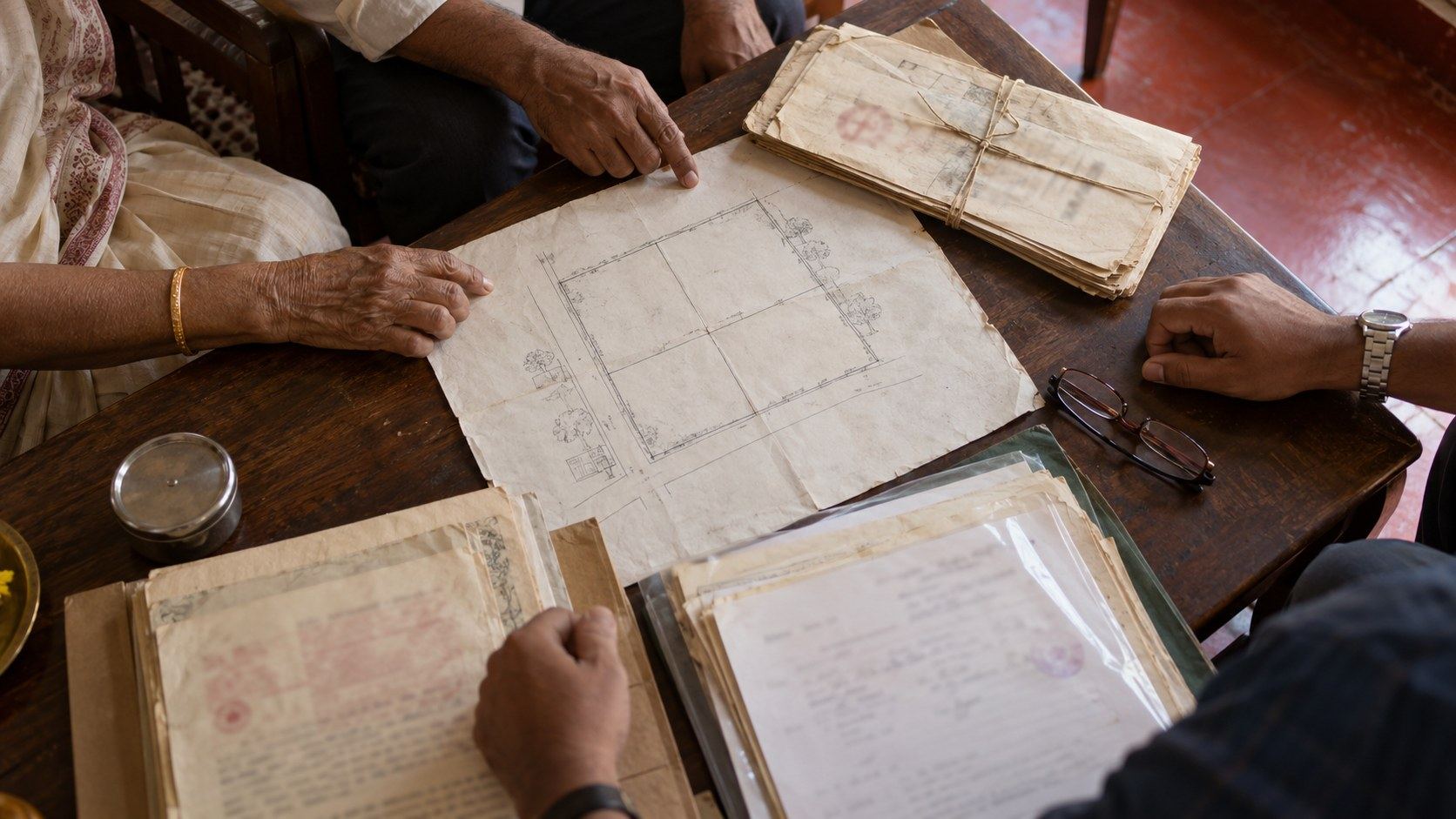
First question: whose property is it?
Everything in a partition dispute starts here. For a Hindu family, the answer usually falls into one of two kinds.
- Ancestral or joint family property (coparcenary property): property inherited through the male line, or acquired from joint family funds. Members of the joint family have a right in it by birth.
- Self-acquired property: property a person bought or earned on his or her own. While that person is alive, nobody else has a claim. After death without a will, it goes to the legal heirs under the Hindu Succession Act. For a man, the Class I heirs include his widow, sons, daughters and mother, who take equal shares.
If the property was self-acquired and the owner left a valid will, the will decides, and a partition suit may not be the right case at all. Our article on legal heir certificates explains how heirs are identified.
For Muslim, Christian and Parsi families, shares are worked out under their own succession laws, but the procedure for a partition suit in court is the same.
Daughters have an equal share
Since the amendment to Section 6 of the Hindu Succession Act came into force on 9 September 2005, a daughter is a coparcener by birth, with the same rights and liabilities as a son. The Supreme Court in Vineeta Sharma v. Rakesh Sharma (2020) held that this right does not depend on the father being alive in 2005.
The main exception is a partition that was already completed before the amendment, by a registered partition deed or a court decree. A family cannot defeat a daughter’s claim by saying there was an oral division years ago without proper proof.
Married daughters have the same right as unmarried ones.
Partition deed: the agreed route
If all the sharers agree, a partition deed is drawn up describing each share with boundaries and measurements, signed by everyone, stamped, and registered at the sub-registrar office in whose area the property lies. Each person then applies for a separate khata, or for mutation of the RTC in the case of agricultural land.
Stamp duty on a partition deed among family members is much lower than on a sale. The exact amount depends on the number of shares and the type of property, so check it on the e-stamp system or with the sub-registrar before printing.
A family settlement that is not registered can cause trouble later, especially with banks and buyers. If you are settling, register it. See our note on sale deed registration for how the sub-registrar process works.
Filing a partition suit: where and how
A partition suit is filed in the civil court with jurisdiction over the place where the property is. For property inside Bengaluru city limits, that is generally the City Civil Court on K.G. Road. For property in areas outside the city’s civil court jurisdiction, such as villages on the outskirts, it is the civil judge’s court for that taluk. Our Bengaluru courts guide has more detail.
The plaint must:
- name every sharer as a party, including sisters, a widowed mother and the children of a deceased brother. Leaving someone out can make the decree useless.
- describe every item of property to be partitioned, with survey numbers, site numbers and boundaries
- explain how the property came to the family and what share you claim
- attach the title documents, the family tree (genealogy), RTCs, ECs and khata extracts you have
Court fee in Karnataka depends on your position. A sharer who is in joint possession pays a smaller fee. A sharer who has been shut out of the property pays on the value of the share claimed. Your lawyer will work out the figure before filing.
Stopping a sale while the case is on
The fear in most partition cases is that the person in possession will sell or mortgage the property before the court decides. Two things help.
- Temporary injunction. You can ask the court, at the start, to restrain the other side from selling, mortgaging or changing the property until the case is decided.
- Lis pendens. Under Section 52 of the Transfer of Property Act, anyone who buys the property while the suit is pending takes it subject to the result of the suit.
Preliminary decree, then final decree
A partition suit is decided in two stages.
| Stage | What happens |
|---|---|
| Preliminary decree | After evidence, the court declares which properties are partible and what fraction each person gets, for example one-fifth each to five children. |
| Final decree | The court, usually through a court commissioner who visits the property, divides it by metes and bounds. If a property cannot be divided sensibly, such as a single small house, the court can order it sold and the money shared. |
For agricultural land assessed to land revenue, the division after the decree is carried out by the revenue authorities under Section 54 of the Code of Civil Procedure.
Many people win the preliminary decree and then stop. Until the final decree is passed and acted on, you do not have a separate, demarcated share you can sell or get a separate khata for.
How long it takes, and how it ends
Contested partition suits in Bengaluru commonly take several years, and the final decree stage can add more time. The length depends on how many parties there are, whether title is disputed, and how many times the case is adjourned.
Courts send many partition cases to mediation or a Lok Adalat, and many family disputes are settled there. A settlement recorded before the court has the force of a decree and can be followed by a registered partition deed. If the family is still on speaking terms, this is usually the better outcome.
Questions people ask
Can a daughter file a partition suit against her brothers in Karnataka?
Yes. Since 9 September 2005 a daughter is a coparcener in Hindu joint family property with the same share as a son, whether she is married or not. She can sue for partition if her brothers refuse to give her share.
What is the time limit to file a partition suit?
There is no fixed deadline while you are a co-owner in joint possession. If a co-owner has been openly kept out of the property for many years, limitation and adverse possession can become issues, so do not delay.
Can my brother sell the joint property without my consent?
He can sell only his own share, and the buyer steps into his shoes. He cannot sell your share. File a partition suit and ask for an injunction if a sale is threatened.
How much does a partition suit cost?
It depends on the court fee, which is linked to your position and the value of the share, and on the advocate’s fee for a case that may run for years. Read our article on lawyer fees in Bangalore.
Talk to us about your matter
Call or WhatsApp to fix a time. Bring your papers to the office in Rajarajeshwari Nagar.
This article is general information about the law as it stood when it was written. Your facts change the answer. Speak to an advocate before you act on it.